by Dr Tom J. Chalko, Australia (© 1997)
This article describes my personal experience leading to discovery of a technique effectively doubling the size of the stimulated electro-photonic glow (aura) around my body in a few minutes in addition to improving its balance and harmony.
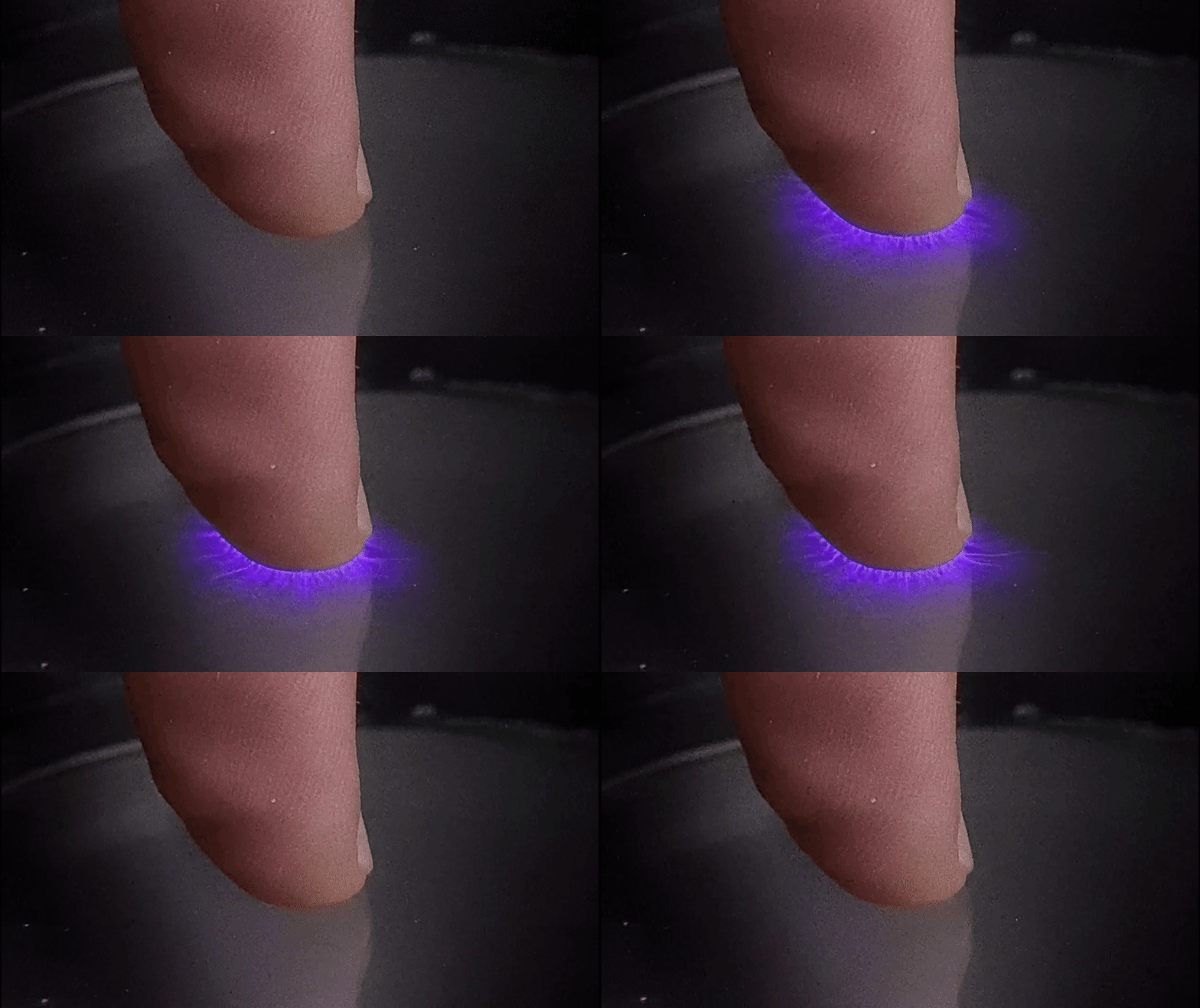
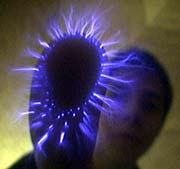
In 1997, after attending two public lectures on electro-photonic medical diagnostics by Prof. Konstantin Korotkov from St. Petersburg and reading his book Kirlian Effect (in Russian), I booked my personal one hour session of electro-photonic health diagnostics with Prof Korotkov.
I asked Prof. Korotkov if I could do some simple conscious exercises (meditation and concentration) during the appointed time. In addition to a standard procedure of taking electro-photonic glow photographs of my 10 fingertips, we recorded my electro-photonic glow during my meditation, took a short break and then repeated the process during my concentration exercise. During my meditation and concentration the electro-photonic image recordings were made in one minute intervals.
When Prof. Korotkov processed the data on the computer, to our amazement, we noticed significant, systematic, coherent and positive changes to my electro-photonic glow during meditation and concentration, indicating dramatic improvement of its size and coherence.
According to the well established principles of electro-photonic medical diagnostics, our results indicated that I could significantly intensify healing processes in my body by performing conscious exercises.
We have discovered a method of consciously improving the self-healing ability of the mind-body system, that has a potential to become a foundation of the natural self-healing medicine of the 21 century. This article contains my personal health data from 1997, kindly provided by Prof Korotkov.
The aim of this article is to quantify the effectiveness of meditation and concentration exercises on the healing process and establish what exercise has the most beneficial influence on healing processes within the body
To obtain instantaneous quantitative measure of how human mind influences healing processes, Prof Korotkov measured changes in the stimulated electro-photonic glow around selected parts of the human body (typically fingertips) using the Gas Discharge Visualization technique (GDV) instrument.
Several types of image processing were applied to evaluate intensity, size and a degree of its fractal distribution of recorded electro-photonic images. To provide a background for further explanation of results, a brief introduction to electro-photonic medical diagnostics is described first.
Every organ and every function of the mind-body system has its distinctive contribution to the electro-photonic glow.
20 years of clinical research, coordinated by Prof Korotkov prior to 1997, reveals that recording an electro-photonic glow around 10 fingertips provides a very comprehensive information about the state of the entire mind-body system.
Fig. 1 presents aura around my fingers, supplemented by a simplified diagnostic chart (based on Prof. Korotkov book [1])
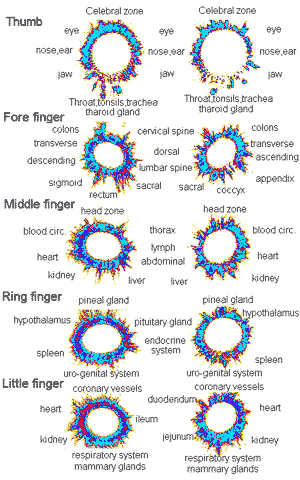
In brief, a discontinuity of the intensity field around any finger indicates the abnormal activity of a corresponding organ, which does not work harmoniously with the rest of the mind-body system. Specifically ''gaps'', outbursts and detached areas of the glow indicate problems or potential problems.
In very general terms, healthy, harmonious activity of the mind-body system is reflected in a regular bio-energy field distribution around fingers, with no ''gaps'', no detached areas and no rapid changes in intensity and shape.
Meditation is an exercise, aiming to prevent thoughts in a natural way, by deeply relaxing the physical body and then trying to keep the mind ''blank''. I have been practicing meditation everyday over the last 3 years prior to the event reported here.

For simplicity, Prof Korotkov recorded the electro-photonic glow around one finger only (fore finger of my right hand), which enabled me to continue meditation without interruption. Prof Korotkov told me, that changes in bio-field glow of one finger are representative for all fingers and therefore for the entire body. 9 images of the bio-energy field recorded in one minute intervals are presented in Fig.2. The first image on the left indicates the initial state.
From the images in Fig.2 it can be seen, that the size of the electro-photonic Aura increases with time. Also, initial ''gaps'' in electrophotonic glow gradually close, indicating that the mind-body state approaches more ''harmonious'' way of functioning.
As a concentration exercise I have chosen the exercise which aimed to practice the communication between two hemispheres of the brain. The exercise is briefly described below and in more detail here. I was observing two circles with perpendicularly drawn diameters, presented in Fig. 3. This picture was located 2 meters away from me on a wall at the eye level.
By changing the focus and concentrating, I aimed to see one circle with a perfect cross in the middle between the two. Then I concentrated, trying to maintain the cross continuously for several minutes. Since each eye is connected to different hemisphere of the brain, the cross, synthesized by the brain is the evidence, that both hemispheres communicate with each other to achieve such synthesis.
I have been practicing such exercise 5 minutes each day for about a week before this experiment.

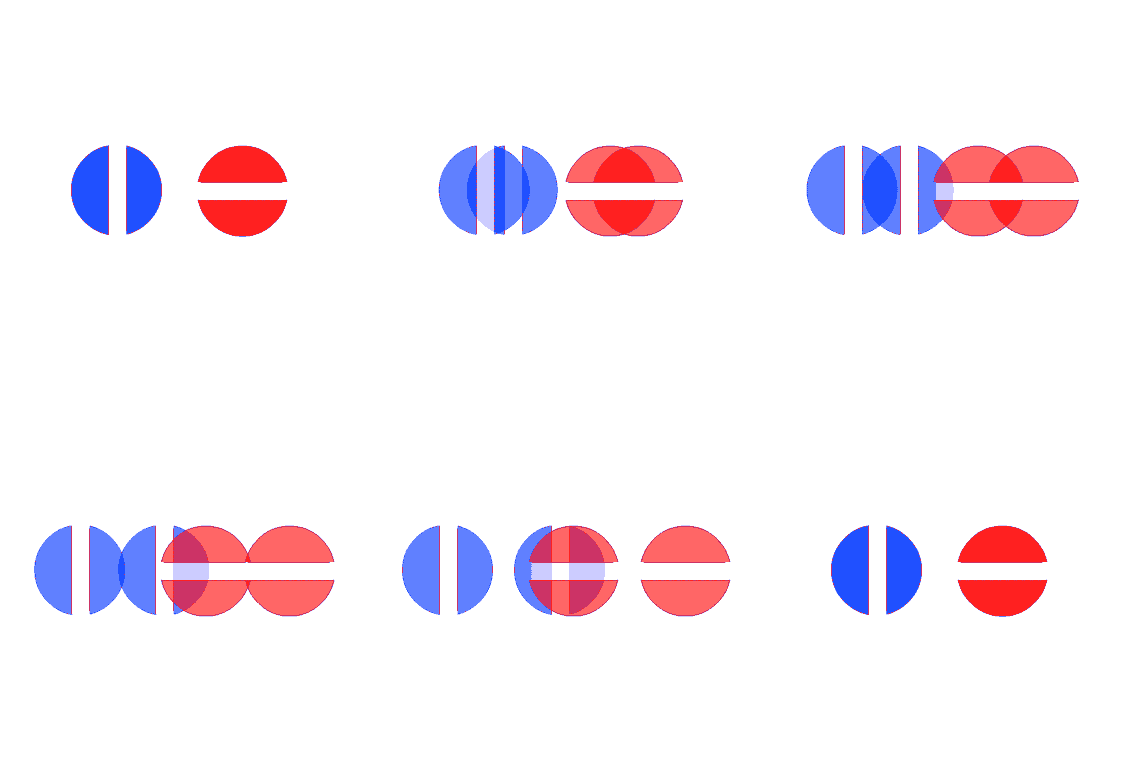
Fig 3a. A hint what you should be aiming to see
Again, for simplicity, Prof. Korotkov recorded the electro-photonic glow (aura) around one finger only (middle finger of the right hand), which enabled me to continue concentration exercise without interruption. 8 images of the electro-photonic glow (aura) recorded in regular one minute intervals are presented in Fig.4. Image on the left indicates the initial state.

From the images in Fig.4 it can be seen, that the size of the electro-photonic glow increases with time. Also, initial ''gaps'' in the glow gradually close, indicating that the mind-body state approaches more ''harmonious'' way of functioning. The degree of fractal distribution of the electro-photonic glow is reduced.
Comparison of results was accomplished by calculating two quantitative coefficients of the electro-photonic glow (aura) for each image:
1. integral of the area of the glow around a finger - the bigger the better
2. degree of fractality (non-uniformity) of the glow distribution - the smaller the better
It should be pointed out, that above coefficients represent a condensed representation of properties of a very complex image.
Both coefficients have been normalized with respect to the initial state, so that their changes relative to the initial state could be easily observed. Graph in Fig.5 presents changes to the glow size and graph in Fig.6 presents changes to fractality of the electro-photonic glow intensity distribution for both exercises : meditation and concentration.
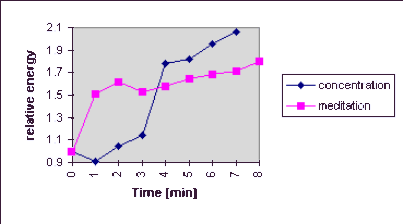
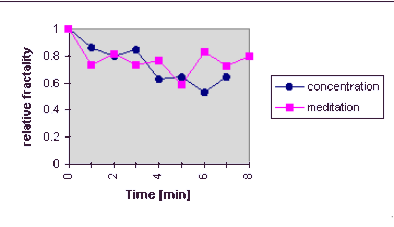
We found, that human aura size as well as distribution not only change significantly during conscious exercises of the mind, but they both can be controlled and greatly improved.
Two types of exercise were performed and their results compared: meditation and concentration. It was found that both meditation and concentration had a very positive influence on human state. They both increased the size of the electro-photonic glow and reduced its fractal distribution.
Results, presented in the context of Kirlian electro-photonic diagnostics, clearly demonstrated the significant influence of conscious exercises on intensifying the healing processes within the body.
It was found, that the concentration exercise was more effective, more consistent and lead to more coherent improvement of the electro-photonic glow than the meditation exercise. Attractiveness of the concentration exercise also lies in the fact, that minimal training is required to achieve substantial results.
Our results demonstrate significant potential of mind exercises in enhancing the natural healing processes. It is clear that more research is needed to evaluate and compare various exercises of the mind and their applicability to healing.
Users of the modern Kirlian electro-photonic equipment today concentrate on the health diagnostics. Presented results indicate that applications of the electro-photonic equipment should be extended to:
It becomes clear, that recording of the electro-photonic glow using modern computerized cameras provides a new insight into mind-body functions and creates a new possibilities in medical research. Measurements based on Kirlian effect are very attractive, because they are not intrusive, instant and provide a comprehensive picture of complex mind-body activities.
In my opinion, learning to interpret the electro-photonic glow recorded using Kirlian effect equipment should attract a significant research effort in the near future, providing a foundation for the new natural self healing medicine of the 21:th century.
[1] K.G. Korotkov, Kirlian Effect, Publisher: Olga, St. Petersburg, 1995 pp 215, ISBN 5-86093-011-9 (in Russian)
[2] K.G. Korotkov, Light after Life, Backbone Publishing House. NY 1996